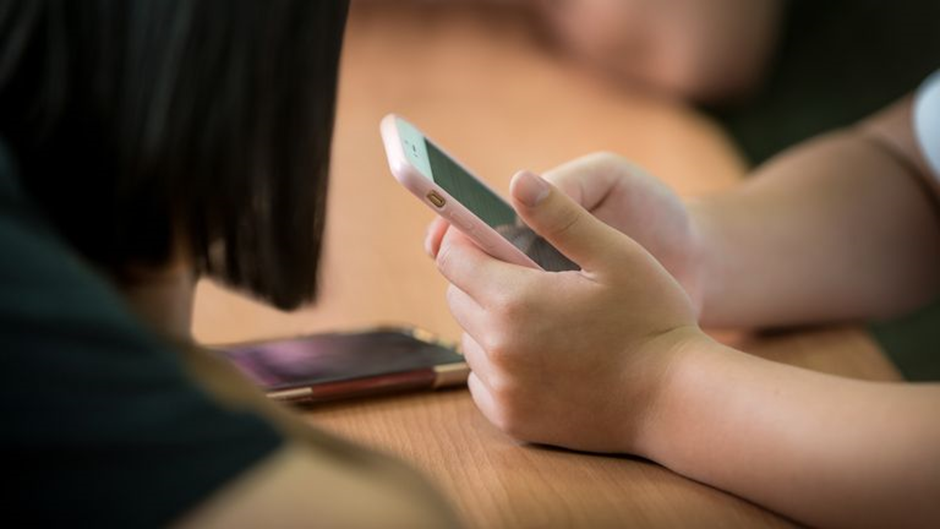
A "whole society" approach is needed to stop children doom-scrolling beyond the classroom with most schools already banning mobile phones, research has found.
Data from the children's commissioner for England reveals 90% of secondary schools and 99.8% of primary schools already have policies in place that stop the use of mobile phones during the day.
However, online safety is still the second most cited concern for school leaders, second only to mental health services.
Children's commissioner Dame Rachel de Souza said the findings show banning phones in schools "will not keep children safe when they go home" and stronger action is needed.
Solutions she will call for include not giving children under-16s smartphones and greater accountability for tech companies, Sky News understands.
Dame Rachel will also call on parents to model the behaviour they want in their children, such as screen breaks, no phones at meals and not taking phones to bed.
“I think this feels true and important to recognise. Children with parents who have a healthy relationship with their phones themselves and have the time and motivation to put boundaries in place will be at huge advantage.”
“What they are saying is valid but is going to be very hard when influences outside of their family are always on their phone. Some education on social media literacy and to help kids and parents be more self aware might be useful.”
“I don’t know if this is something that needs to be governed, rather than being an issue (that is definitely a big issue) that needs to be fixed by parents, maybe by a campaign or more lax rules on social media ages etc”
“I am supportive of this, I feel phone use in our society generally is having a negative impact and especially on children who at often put in front of screens instead of engaging with the world around them. It is becoming increasingly harder to police what is seen on line”
“I agree with this to an extent that what is being used with phones are not productive and is clearly an adverse effect, we’re living in an attention economy built on algorithms who don’t care for the human but only their wallets. This is not a good mannerism to build for children whom are developing”
“A good idea. I do anticipate that implementation will be very difficult. The root cause of the problem is societal. Any strategies restricted to kids is unlikely to work”
“while the usage of social media and phones is quite concerning, it will definitely be difficult for tech companies to put such limits on age and time used. I doubt this will work.”
“No smart phones for under 16s seems like a tall order. Greater accountability for tech companies, who's own research shows teen mental health improving after quitting social media, seems to be the way to go”
“I feel tech companies should absolutely be held accountable. Kids shouldn’t be exposed to addictive algorithms at such a young age but its basically impossible now.”
The research showed nearly a quarter of children spend more than four hours a day on an internet-enabled device.
The data includes responses from 19,000 schools, making it the most comprehensive evidence to date on mobile phone policies in the classroom.
It found most schools had strict rules, including not allowing phones on to school grounds at all, requiring pupils to hand them in or requiring them to be kept out of sight.
Secondary schools were more likely to allow some phone use, with about 10% permitting it during breaks or lunchtime.
The children's commissioner said the findings prove that most schools already have phone policies aligned with the Department for Education's non-statutory guidance.
This was introduced by the Tories last year, but the party now says headteachers should be legally required to ban phones from schools, something Labour has ruled out.